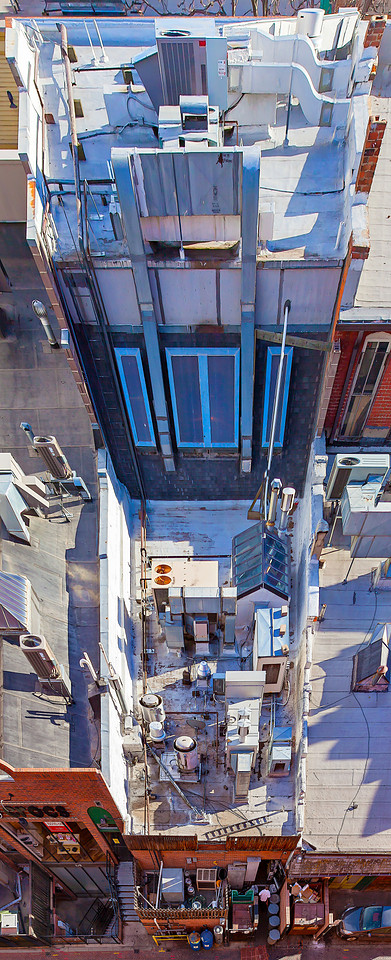
Distorted Perspective: Bending the Laws of Physics
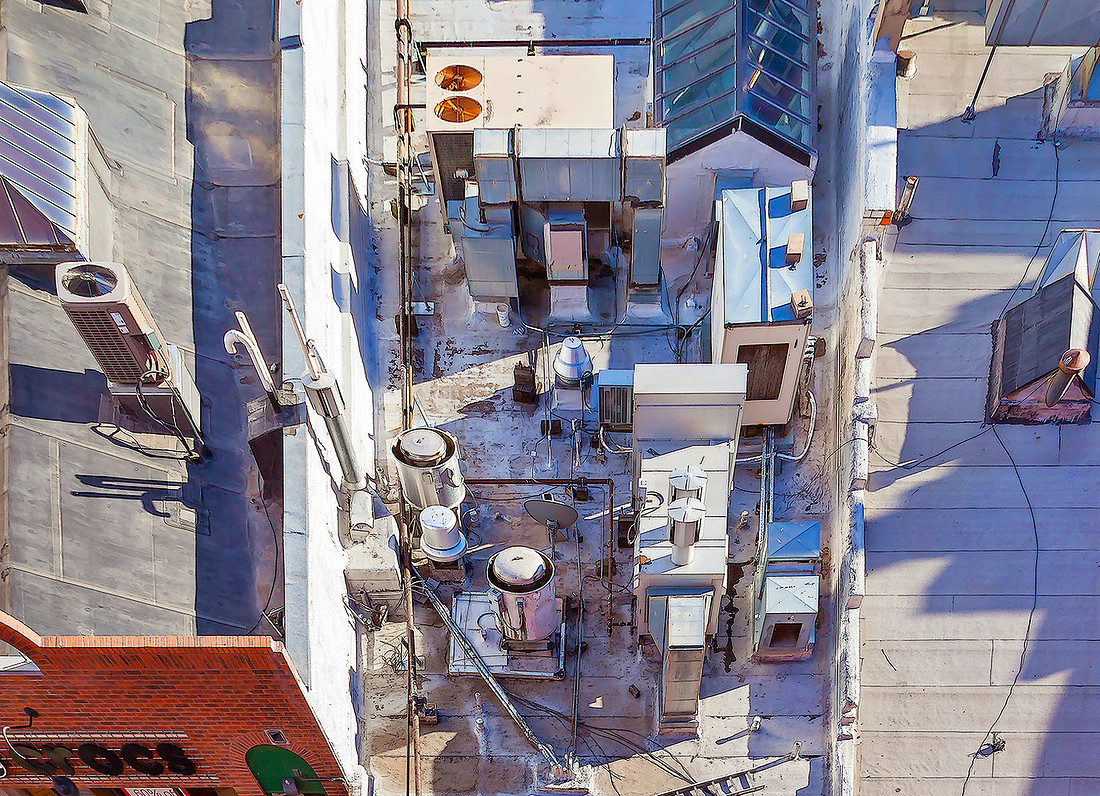 Rooftop Structures, detailShadow, shape, and surface texture are very evident in this detailed view, and are what initially drew me to this subject. Notice some shape distortion, especially near the right and left edges of the image, as a result of the process described below.
Random Utilitarian Objects
When I first spotted this view, looking down from the nearby parking structure onto the back end of the Flanders Brewing Company on Boulder's Pearl St. Mall, I was fascinated with the details of the myriad of mechanical objects and forms on the roof—most with which I was not familiar—and the shadows that they cast. I find such chance views of utilitarian objects—which aren't designed to be seen—to be more visually interesting than the more “aesthetically pleasing” intentionally designed public facades of such buildings. This idea is, in fact, at the heart of most of my urban photographs. I took several photos of this rooftop, becoming intrigued by the form and depth of the rooftop objects, the angled light falling across them, and the resulting shadows.
Rules That We All Obey
I became aware of the visual potential of this rooftop scene as I examined my photos of it. This is a one-point perspective view. As you may know, there are properties and rules that dictate how we interpret the space and objects around us. They enable us to navigate safely in the world. We couldn't walk, ride a bike, or drive a car safely if our minds failed to very accurately use visual cues like size, depth, and proximity to avoid colliding with objects or falling off edges. Our biology helps us with binocular vision, which I discussed in a previous blog. Another way we perceive depth and distance is as a result of linear perspective. This “law” states that all parallel lines or edges in a scene that recede from view appear to converge, eventually meeting at an imaginary vanishing point, usually on the horizon. Because our eyes and minds know this law, we judge distance by the type and degree of convergence of parallel lines (in a natural setting this is less obvious, but still present). All scenes contain one, two, or three-point perspective, or a combination. The photograph below is a classic illustration of one-point perspective.
 Sunlight and ReflectionAll parallel lines moving away from the viewer converge, meeting at an imaginary vanishing point. Here it is in the upper right area of the rectangular window at the far end of the corridor. If parallel lines don't move away from the viewer, such as the horizontal girders crossing the ceiling, or the vertical window dividers along both sides, they appear parallel, as they physically are. This is a one point perspective view, because only one of three dimensions recedes from the viewer (and thus visually converges).
What If Those Lines Didn't Converge?
In the real world, if parallel lines didn't converge as they receded from view we would be confused and disoriented, experiencing a type of surreal vertigo, not able to function because we wouldn't know where we are in relation to our surroundings. But what if you tried tweaking the perspective of a photograph? The photo below of the Flanders Brewing Company seemed like a good candidate due to its strong one-point perspective. I immediately began to explore ways to enhance the birds-eye viewpoint, as if I could take off and float above it. Also, I liked the strong compositional structure of the side walls of the central roof as they receded into the distance, forming borders for the very interesting shapes within them on the rooftop. I asked myself “What if those edges didn't converge as they receded? What if I could make them visually parallel (as they are physically)? How would it affect the image?” Fortunately Adobe Photoshop provides tools and filters with which to do just that.
 Rooftopo Structures- original & distortedLEFT: Notice that all parallel receding edges converge as they move into the distance visually (indicated by the red arrows). They will eventually meet at an imaginary vanishing point.
RIGHT: The entire image has been distorted in Photoshop so that these same parallel edges are now pretty close to visually parallel (red arrows). To do this the top of the image had to be stretched apart in relation to the bottom, distorting all dimensions drastically.
Rooftopo Structures- original & distortedLEFT: Notice that all parallel receding edges converge as they move into the distance visually (indicated by the red arrows). They will eventually meet at an imaginary vanishing point.
RIGHT: The entire image has been distorted in Photoshop so that these same parallel edges are now pretty close to visually parallel (red arrows). To do this the top of the image had to be stretched apart in relation to the bottom, distorting all dimensions drastically.
Controlled Distortion
What I discovered upon distorting the original photo to the point of making the receding, converging edges of the roof parallel were several inconvenient facts. First, the resulting trapezoidal shape of the picture would be difficult to print and/or frame. I could solve that by cropping the image to a rectangle. Second, because I had to apply such an extreme distortion to get those edges parallel, the entire photo got distorted in terms of proportion, shape, and even resolution (you can expand pixels only so much before there isn't enough pixel information to keep it sharp). So I stretched the resulting image vertically to reduce the primarily horizontal distortion, and fortunately I had shot a high enough resolution image to have some margin for lost resolution. The final issue was that the shapes in the distance that were the most distorted (the one story second level that is seen at the top of the image) became huge in comparison to the foreground shapes (in the alley at the bottom). I decided that I liked this—in fact it seemed to enhance the effect of not knowing exactly where you are as the viewer, lending a sort of fantastic quality to the image, and it fit well within the shape of that upper half of the image.
Final Touches
The final image includes parts of the alley that were not in the original. Before distorting the whole thing, I spliced this area, from another photo of the scene, onto the bottom to add some foreground context. I did some final editing, such as slight cropping, and color, tone and contrast adjustments, which I often do with pictures that include sunlight and shadows, as a way of enhancing the special quality of light that we experience in Colorado. I was satisfied with the resulting focus on the fascinating shapes that, because of their rooftop location, most of us don't often see. And I liked the late afternoon shadows falling across the scene. It's not always evident when you start out what you are going to get with an experiment like this, and I have tried some that didn't go anywhere. But whether they work or not, the process is a part of why I love photography, and the digital tools available to push its boundaries.