
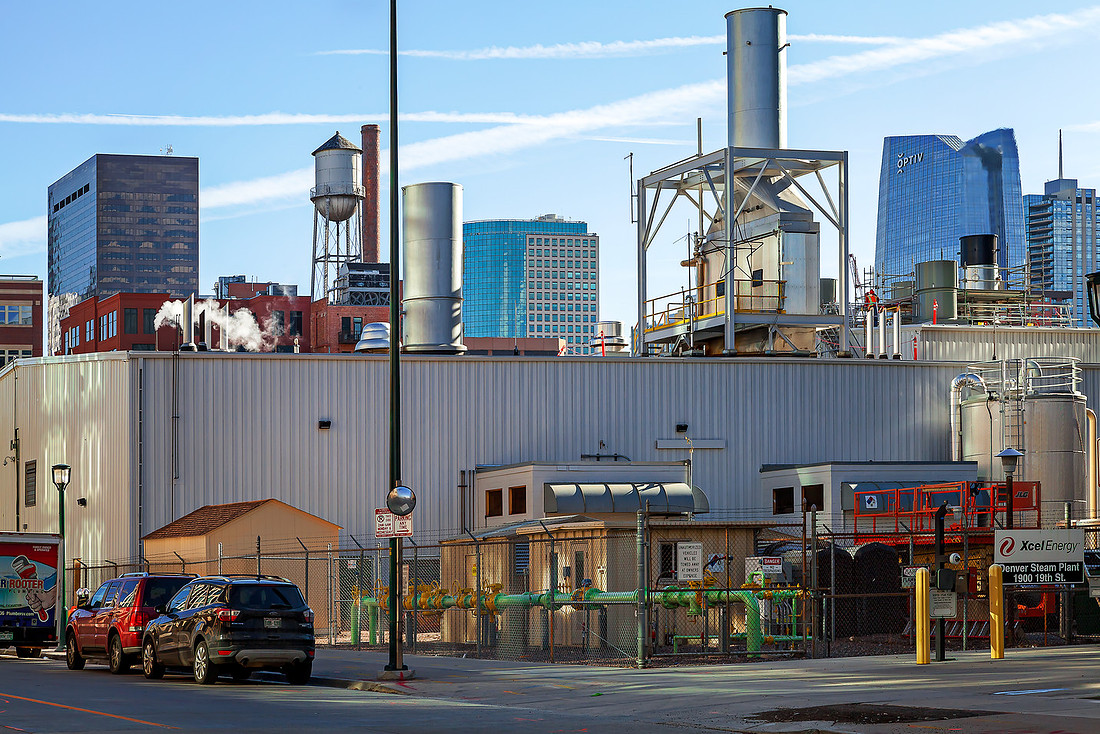
 Lodo Steam Plant
The "Real Abstraction"
"Even though you might have these ugly structures, nasty, smelly cars, and dirty streets, when you look at it all as a picture you don’t think of that—you look at it as visual organization. In a way this is the real abstraction—to abstract the visual from the reality..." Richard Estes, Painter
In my urban photographs I explore the three-dimensional city as a means of transforming it into separate, visually related, two-dimensional images. The flat plane of a photograph—ink on paper (or pixels on a screen)—can only suggest the almost infinite range of light and depth we experience as humans. It is an abstraction, and as such has its own characteristics and potential to communicate.
My interest in taking pictures in the city is at odds, seemingly, with my passion for being in the out-of-doors. I get energized and renewed being in nature—the wilder and more remote the better. A part of that is photographing the beauty of the mountains and canyons of Colorado, or the forests and beaches of Oregon. Yet, when seeking moments of creative photographic inspiration I return to the geometric, utilitarian, multi-layered, and often random shapes, forms, and textures found in the city, to investigate with my camera the intersection of three-dimensional reality and two-dimensional abstract visual design.
Altered Awareness
When I consciously and logically consider the concept of city—civilization and human “development”—as an entity, I find it to be in direct conflict with my deep reverence for nature. The grating noise, the toxic pollution, and the utter disregard for environmental sustainability that underlie the never-ending growth of the urban area are the very things from which I seek a respite in the wilderness.
But, ever since I first noticed the way a bridge frames the view of a factory in the distance, for instance—creating unexpected angles and visual relationships, or how a scene reflected in a store window is distorted into abstract fragments, overlain in rich depth upon the shapes visible within the store, I've learned to recognize a sensory and perceptual shift that takes place in such settings. I'm drawn into a new state of awareness, without judgment, focused purely on visual and spatial relationships, perceiving the underlying abstract designs that emerge, both defining and blurring the distinction between two and three dimensions. Such moments, in fact, began to shape my artistic identity long before I considered myself an artist/photographer.
A Visually Rich Environment
It is this state of suspended judgment and shifted awareness that allows me, perhaps, to come to terms with my rational evaluation of civilized society. By finding beauty, often in the least likely locales, I can experience a creative serenity in the crowded, noisy, dirty city by exploring and capturing my visual experience of it, independent of the voice in my head that evaluates and critiques it. It's not that this voice disappears, or that it is unimportant, but it is silenced for a time, allowing me to immerse myself in photographic discovery of the visual wealth of the urban environment. I've thus learned a way to balance my distaste for certain aspects of the city with awe for the infinite beauty, both intentional and unintentional, of this flawed, difficult, human-created world. Call it what you will—right-brained vision, artistic perception, or transcendental observation—it allows me to understand and appreciate the city more deeply—even to embrace this setting where the majority of us in the modern world live and work. This process has resulted in the images you see on my website.