
Black Canyon of the Gunnison: “Undiscovered” Gem
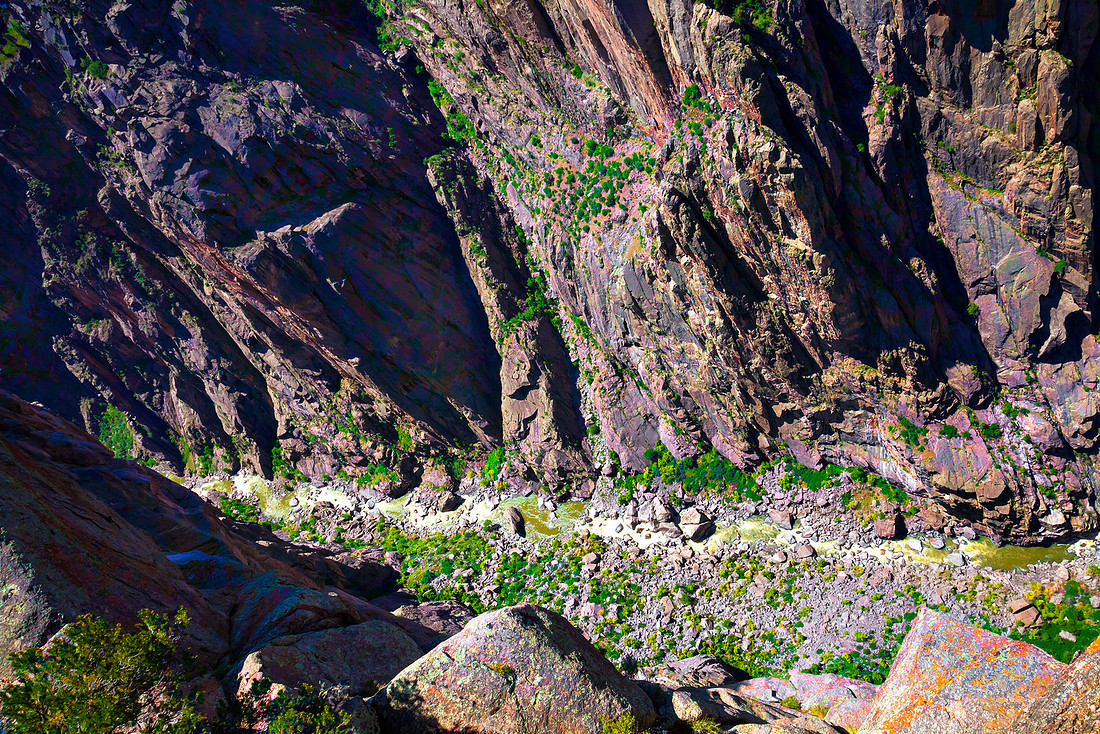 Into Black CanyonMid-June, midday view from the north rim down to the usually shaded bottom of the Black Canyon some 2000 feet below, illustrating the power of about 2 million years of erosion by the Gunnison River, seen here in a relatively low flow year.
Awe-Inspiring, Sheer-Sided Depths
Perhaps the most awesome—and obscure—gorge in North America was formed as the Gunnison River carved through nearly 2 billion year old Precambrian rock over the last 2 million years to form the Black Canyon of the Gunnison in western Colorado, the centerpiece of its namesake national park. Geologist Wallace R. Hansen summed up its character nicely:
Several western canyons exceed the Black Canyon in overall size. Some are longer, some are deeper, some are narrower, and a few have walls as steep. But no other canyon in North America combines the depth, narrowness, sheerness, and somber countenance of the Black Canyon of the Gunnison.
Having stood on the brinks of such iconic and breathtaking chasms as the Grand Canyon, Hells Canyon, the New River Gorge, and the Columbia Gorge, I wasn't quite prepared for the magnitude of the physical sensation I had upon first encountering this abyss. I had to literally step back and take a breath or two to adjust to the terror induced by peering into the gaping void. My wife Maxine and two-year old daughter Ali were with me as we stood at the Chasm View lookout on the North Rim. In spite of the sturdy three-foot fence at this point I don't think I ever released my firm—if clammy—grip on Ali's hand during the 15 minutes we explored the rim.
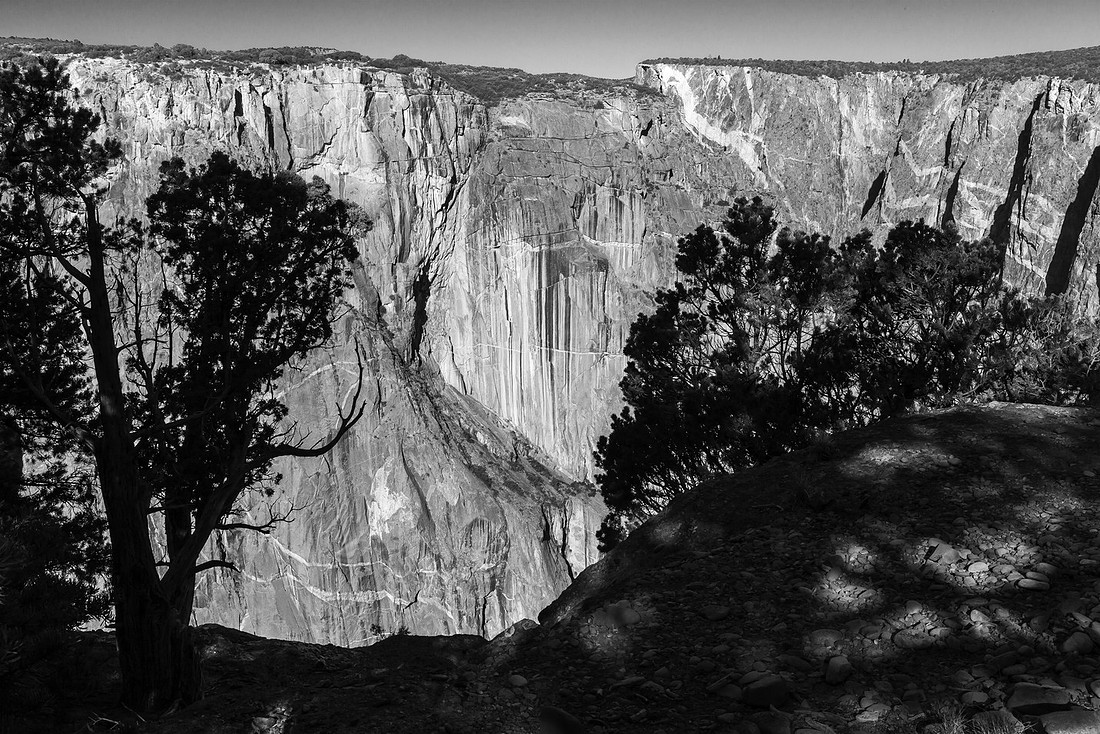 Sunrise on South WallLooking across the canyon, deeper than it is wide at this point, to the face of the south rim of the Black Canyon. On a typical late spring/early summer day one can pick out the ant-like forms of rock climbers inching their way up these sheer cliffs.
Climber's Paradise
Over the years I have returned regularly to the Black Canyon. I've come to the opinion that it is Colorado's foremost natural feature. Not only is it an exhilarating place to explore and take pictures, but due to its relative isolation it receives very few visitors compared to most national parks, and offers unrivaled opportunities for solitude and serenity, especially the less-visited North Rim.
This is a rock climber's paradise. I often wake up in my tent at the North Rim Campground to the jingle of climbing hardware as a party sets out to explore and descend the 2000 foot sheer walls below. There are numerous technical routes on these vertical cliffs rated from 5.9 up to 5.13. Though I've never tried one of those, I did once attempt a foray down into the canyon on a very rocky and torturous trail clinging tenuously to a knee-achingly steep ravine. My trek ended at an impassable thicket of poison oak about halfway down; I could not find a way through, and wasn't about to subject myself to the known horrors of a case of poison oak! There are plenty of challenging trails on the canyon rims for exploring and taking pictures.
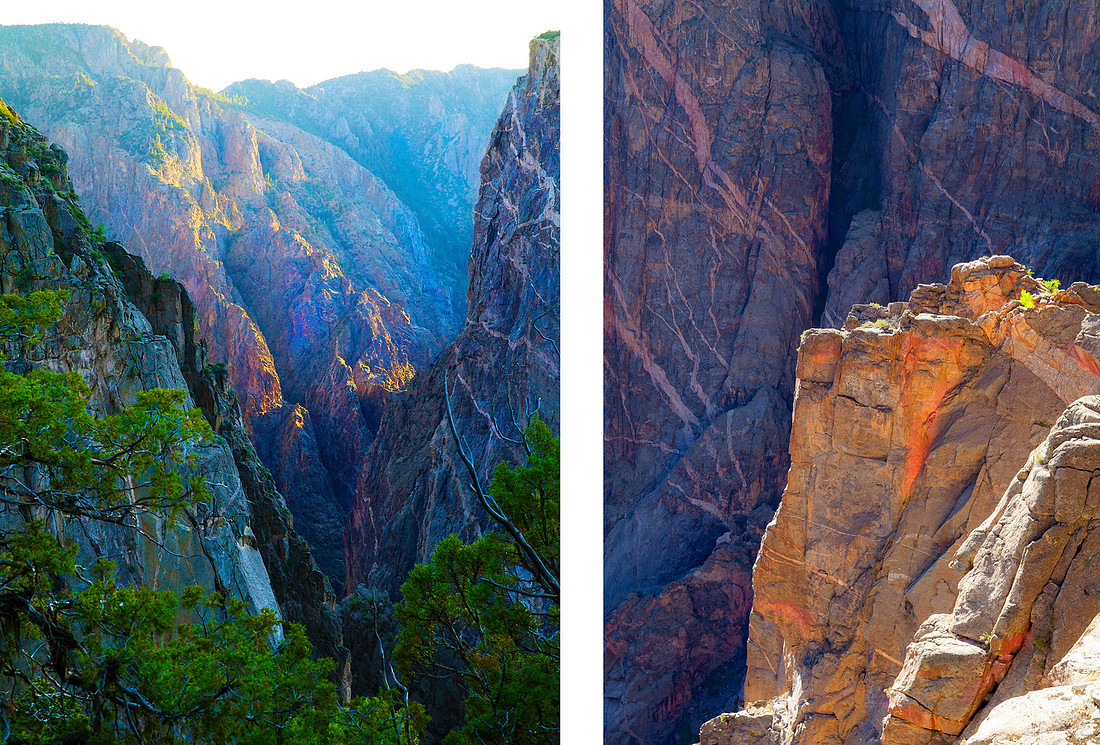 LEFT: Sunset in Black Canyon; RIGHT: Canyon InterludeLEFT: The last rays of the setting sun illuminate colorful granite crags in the canyon below the Painted Wall. RIGHT: Sunlight illuminates and reflects onto a rock outcropping, contrasting with the streaked Painted Wall in the background shadows.
Photographic Methods & Techniques
I've adapted some basic techniques for shooting photos at Black Canyon. Whenever possible I use a tripod, for a couple reasons. First, I often use a small aperture setting (f-16 or smaller) for greater depth of field, and thus a slower shutter speed. Second, the deep shadows in the depths of the canyon generally don't provide enough light for a fast shutter speed. In either case, hand-holding the camera is not a reliable option for sharp focus. And, I often take evening or night photos at exposures of multiple seconds—impossible without a tripod.
There are times that it becomes too awkward and unwieldy to carry/use a tripod—like on the edge of a rock overhanging the canyon, or on a very steep slope (though some slopes allow stabilization by adjusting tripod leg lengths). In these cases I practice the art of bracing. Either I lean an elbow or shoulder against a solid object like a rock or tree as I steady the camera, or I lay on my belly or sit and brace my elbows on the ground or my knees, respectively. For the picture Into Black Canyon above, I crawled—very gingerly—to the edge of a rock perched 1800 feet above the river. It took all the self-convincing I could muster to inch my head out over the rock edge, then hang my $3000 camera (strap securely fastened around my neck) out even further to click the shutter a few times, all the while adjusting composition, focus, and shutter speed. A tripod wouldn't have worked here. I had to hold perfectly still to focus, but also because whenever I squirmed around to adjust my view I began to slide toward the canyon's edge, since the rock upon which I was positioned had a slight downhill tilt to it. I breathed a sigh of relief as I finished these shots and scampered to safety; I wouldn't necessarily recommend this procedure!
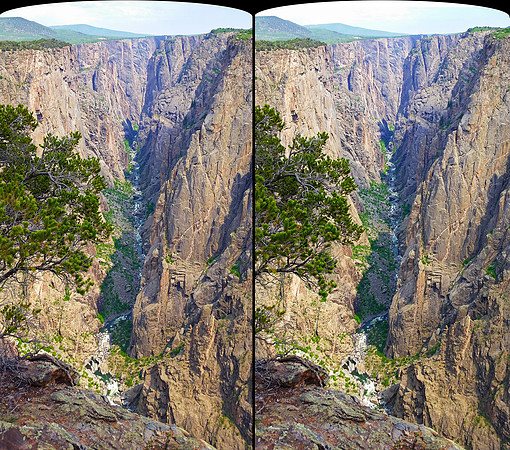
The above image is a stereo (3-D) photo. Hold your mouse over it (or, for cell phones, click it) for instructions on how to see its three-dimensional depth, or click it for instructions for how to take a 3-D photo.
I hope you enjoy my photographs. Please click here (or on the photo Into Black Canyon at the top) to view my entire portfolio of Black Canyon photos. I feel I have just scratched the surface of the photographic possibilities, and my next goal is to shoot winter scenes here.
I invite you to comment, ask questions, or relate your own experiences at the Black Canyon (Leave a Comment link at the top, or Add Comment button below). Here are some resources for more information about this surprising and stunning jewel of our National Park system:
-
U.S. National Park Service information on the Black Canyon of the Gunnison
-
5280 Magazine article on the Black Canyon.
-
New Mexico Geological Society excerpt from Wallace R. Hansen's geologic and physiographic study of the Black Canyon.
-
Technical climbing information and routes.
-
Alpinist Magazine feature on the Black Canyon.
